THE DISMAL ALIENS
The ladybird is a highly valuable insect for controlling aphids. Unfortunately it is being overrun by another beetle. This is the dismal truth of the Harlequin Beetle Harmonia axyridis. Following introduction into America in 1988 it has now become more widespread there than ordinary Ladybirds. Now it is advancing rapidly through the U.K.
The Harlequin was originally introduced for its voracious appetite for eating aphids and so protecting crops. But things have got out of hand. If its success continues it could result in a reduction in biological diversity i.e. the number of different types of insect that we have in our gardens. That is not good.
Plans are being made to control it e.g. by using insect attractants to lure the Harlequin into a trap. I recommend that gardeners learn to distinguish the Harlequin from normal Ladybirds. see the Harlequin Survey. It seems only right to keep a keen eye open for them and destroy them where they are found. Anything to halt their advance must be good.
...and FLAT WORMS
The New Zealand Flatworm, Arthurdendyus triangulatus, is another alien, first found in 1963 in Northern Ireland. It has probably traveled among potted plants and now exists throughout the U.K. Other reports suggest that eggs may travel in stone filled field drains.
This Flatworm eats our own native earthworm. In some areas this alone is blamed for causing poor field drainage and waterlogging - a devastating result.
As organic gardeners we need be more responsible custodians of our environment.
Wednesday, November 08, 2006

Wednesday, November 01, 2006
AUTUMN RASPBERRY GOLD LOVES COLD
My autumn Raspberry 'All Gold', described earlier, has come into fullness this week.
Although I've been getting Raspberries for over 2 months, they are much better now. They are firmer, they stand better, free of molds, and taste good. The colder weather is doing them good.
A month ago I was waiting for the calyx (i.e. the leafy appendiges beneath the fruit) to curl back to indicate the fruit was ripe and good to eat. The space between ripeness and decay was quite short. I've had very few in recent weeks. But I had noticed that there were many green fruit yet to ripen.
Well now they are swelling to become fat jucy fruits that remain good on the branch, but eventually, they are just too big and good not to be picked.
Don't forget - you can add your comments on any of my notices. Thanks for reading.
Sunday, October 29, 2006
 My soil contains sufficient clay to form these smooth shapes My soil contains sufficient clay to form these smooth shapes |
This week has brought a lot of rain. With lower temperatures 'to boot' the garden has reached that 'tipping point' where the soil is too wet to work on. Any work with rake or cultivator turns it to mud.
I can only hope for an extended spell of drier days that may allow me to do a few outstanding jobs. I can now look forward to jobs like pruning fruit, moving a few shrubs, paving stones and putting in a few posts.
The wormery is very active!
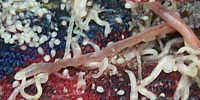 | Photo shows a small part of a mass of tiny baby worms and worm eggs |
Note: while many garden centers promote herbaceous perennials and shrubs during their summer blossoming, that is in not a good time to move bare rooted plants. But now is a good time to plant new shrubs. See transplanting shrubs on the Organic Gardener.
Tuesday, October 24, 2006
LEARNING TO SWITCH OFF
Hello again. Today there have been more reminders in the news about how to reduce energy demands. This is necessary to slow the sharp rise in 'greenhouse gas' that is threatening our environment. While switching off electrical appliances that are on stand-by, and battery chargers left plugged in etc... were mentioned, I'd like to give a few ways to save energy in the garden.
Overall the massive and widespread expansion in the use of power seriously threatens the environment that sustains us. The development of power machines for every kind of domestic gardening job must also add significantly to this energy drain.
Nowadays, summer weekends in suburbia are shattered with the roaring din of not one, but many types of power machines all over the neighbourhood: mowers, hedge trimmers, blo-vacs, lawn scarifiers, strimmers, you name it. It seems that no one knows how to do a job without a plug-in. Nationwide 'power gardening' alone must cause a massive extra drain on resources and cause a massive significant increase in carbon dioxide production to generate the power needed.
But do these machines help us as much as we think? When I need every bit of encouragement to get out and mow the grass I find the thought of dragging out a heavy mower and messing around with electric cables is just enough to put me off. Wrestling with trailing cables for me, simply spoils the fun of gardening.
By contrast my manual mower is small, light, easy to get out, and carry around, and it can be wizzed around the lawn in no time. In fact, I can almost run with my side wheeled mower - and it does a good job on the grass too. (You've probably guessed that I'm frequently in a hurry.)
There's no doubt in my mind that for a normal domestic garden situation, a power mower is a waste of energy - and I feel so much healthier and fitter after doing the grass with a push mower.
If you must choose a power mower then can I suggest not getting an oversized mower. The extra weight, storage space and manouverablity are considerations. Take hover mowers for example. Qualcast only make a small hover mower because the additional weight of a grass box and the more powerful heavier motor that is needed - ...yes, to lift its own weight! - is so inefficient. A link to more detailed discussions on using and choosing lawn mowers and lawn care is on this page.
IS AFFLUENCE THE MEASURE OF ILL-HEALTH?
I believe that power machines, including cars, are for the elderly and the disabled, and those rough gardening situations (e.g. slopes), that call for a heavy duty machine. But they are also often used by the unfit (or, dare I say, lazy). But don't kid yourself that obesity is fashionable or good. Get into your garden and get healthy. With fresh organic food it gives you just about a complete work out.
Now if you're stuck in an office on weekdays you can really look forward to the garden at weekends.
First: flush out the stuffy office with a few deep, deep breaths in; each followed by an exhale right, right out...
Then do a few gentle bending and stretching exercises... do you feel better now?
Then get on with the lawn and take in the gentle smell of the fresh mown grass, cut chammomile, lemon balm etc...
It's a question of priorities where quality of life comes first. I hope that you have a good harvest.
Friday, October 13, 2006
BE ORGANIC, COMMUNITY MINDED & SHARE YOUR GARDEN PRODUCE
The benefits of sharing with neighbours are obvious for anyone who has a big harvest. If you can in return get something back that you didn't grow then you can serve up a more exciting meal.
If a glut of garden produce only serves to feed everyone on the same meal for weeks until they are literally fed up with it, then it is not going to be appreciated. But a varied diet is usually a good thing.
How much better if you can be community minded and help each other out. Perhaps even arrange to grow different crops so that you can all share and have a little of everything.
This year one of my neighbours kindly brought around a large bag of tomatoes, while another supplied an equally large bag of plums. I have returned with a small share of my potato crop.
Also speaking of neighbourliness, don't forget the elderly who can't so easily get out to shop or even perhaps to grow in their gardens. They are always very appreciative of fresh garden gifts as they grew up in an age when cooking was the norm unlike the fast-food fanatics of today.
Friday, October 06, 2006
CATCH-UP REVIEW ON 2006 SO FAR
In the U.K. we had the hottest July on record. The dry days affected flower set on the runner beans. This year I grew them over a walk-through arch to save space and make picking easier. I constructed the arch from Willow Cane - see my pages on runner beans.
But the hot July was followed by an overcast and often wet August. I needn't have worried about the runner beans. A bumper crop emerged for harvesting in September and October. It's just finishing now but I have 3 shelves in my deep freeze full with bags of beans.
Once again my autumn raspberry variety All Gold is producing a good crop. There's still fruit waiting to ripen today.
However the wet August and September has put a dampener on things with some fruit spoiled and others quite literally tasting watered down. But I'm still getting handfulls of good tasting firm fruit - and eating them does make me feel better.
This variety seems to be very resistant to Botrytis. Where there is some infection I pull off the fruit but adjacent fruit usually remain perfect.
Also they haven't been attacked by birds, perhaps their yellow colour is less attractive.
My next door neighbour got a bumper crop of plums. My plum tree is only small in it's second year but it gave a very promising crop of fruit. I've put in several apple cordons and one has fruited in it's first year. I've pruned them now.
Also this year.
I grew several potato varieties, in the garden and in potato bins and tubs. I'll be comparing them on my website.
My crops following a green manure and organic fertilizer have been boosted.
Not so good -
a tomato variety 'Italia' grown outdoors.
It provided a sizeable crop of green square shaped tomatoes. The only problem is that they didn't ripen.
But I find the square shaped fruit a big advance when it comes to slicing.
Finally the grass has benefited from Fish, Blood and Bone, organic fertilizer and, a new push mower that can quite literally be run over the grass. It's easier to use without cables, and maintain etc... and so I tend to do it more often. See growing lawns
BACK ON THE BLOG
I'm returning to publish my blogs on these pages. Here's the last blog from my website Home of the Organic Gardener. I'll follow this soon with a few catch-up blogs to review what has been a busy and exciting gardening year.4th April 2006 - Gardening Diary Entry
GARDENING PLANS FOR 2006
Well the seed potatoes have arrived and the new fruit cordons - 3 apple varieties, plus a Jostberry, and Tayberry.
I've bought a new push mower.
I'm going to try a different method of growing runner beans arching over a taller long tent of canes. One more for the gardening diary a little later.
21st March 2006 Gardening Diary Entry
THIS SPRING BEGINS WITH WATER SHORTAGE ?
I've since published a page with detailed advice on watering the garden.
It's true! Important resevoirs supplying the U.K. are virtually empty. Low pressure areas with rain bearing weather fronts are off course way up north... or perhaps it's the jet stream. Drier continental highs cover central and southern U.K.
Hose-pipe bans are planned already. Gardeners and all are discouraged from wasting water - washing patios and cars etc... needless to say... don't leave taps running and, do remember to turn the tap right off when finished.
Oh dear, gardeners are in trouble. We'll be awash with argument on what water usage is banned and what is allowed - allotments OK, gardens hoses at home NO, Car washing services OK, car wash in your own drive NO ???
AS ALWAYS I'LL TRY TO SUGGEST AN ORGANIC SOLUTION FOR GARDENING
- Cultivate deeply. Deep roots gives your plants access to more soil water. Click here for an easy way to build raised beds.
- Let the grass grow longer to encourage deep rooting.
- Ensure plants grown from seed for transplanting develop deep root runs - see Rootrainers.
- Avoid containers, but if you use them ensure the surface is covered in plastic or grit to reduce evaporation.
see container gardening - Use plastic sheet or loose mulch to reduce water loss to air. See my pages on mulching
- Incorporate plenty of organic matter into soil - leaf mould, garden compost, manure, etc...
- Water your garden plants early morning or evening. One good watering is better than many light waterings. Don't spray water into the air.
- You should have been saving whatever water you can collect. There are some good space-saving water butts available that can tie into down spouts from guttering. Go to Water Butts at Ferndale Lodge...
- Lay a narrow perforated pipe under the soil to the outer root zone weaving between plants.
Friday, January 13, 2006
The Box Next Door
By now you may have seen Blue Tits already looking around for possible nesting sites - this post is a bit late.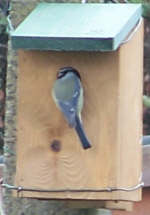 I'm always curious to see them checking the bird boxes. They land outside the hole, and with all the mannerisms of a nosy neighbour, look inside while checking around outside as if to see that no one is watching them.
I may be wrong but I believe that they are scent marking the hole, perhaps using oil glands around their beak, so as to keep their rivals away.
Well if you haven't put up a nesting box by now, it may soon be too late.
Last week I noticed a finch come down to the water when it was frozen. Instead of water it splashed the frost over its wings. Do leave out some food and unfrozen water for the birds.
Saturday, December 31, 2005
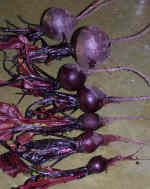 |
| boro f1 hybrid |
I left my beetroot in the ground as I only had a few. But it was very satisfying to go down the garden on Chrismas Eve and dig up a handful or two.
After washing and cleaning I took half to a friend and the rest I peeled, before cooking in the microwave for eating with a cottage pie, sprouts and peas. I think it is important to remove all the peel as it can add a bitter taste. Also, I found they need exta cooking time to other vegetables.
I had noticed a month ago that the beetroot leaves stained the white frost red from the juice leaking out. Although they discolour water these roots didn't bleed even when cut. In the picture the dark patches are on moist areas, the light areas have dried. They do need to be kept moist.
I think it is better to lift beetroot in late autumn and store in moist peat or vermiculite contained in a ventilated box. Just a couple of these roots had a small hole, nothing to worry about. But storage reduces the risk of pest damage as well.
Sunday, December 18, 2005
Christmas Post an Organic View
 |
| Thank you Eric & Beryl for the lovely flowers |
 |
 |
| Thank you John; this year the Poinsettia looks even move vivid & the flowers inside the red bracts larger & more promising. |
Yet sending Christmas cards is also one of those things that happens to gardeners. Christmas preparations are like a flower coming into bloom and then moving on to make seeds. Happily I've completed and posted my Christmas cards for 2005. In case you don't receive one from me, may I wish you all a happy Christmas.
But I also detect that some of you organic gardeners may not send Christmas cards at all. Why ? Because it's too commercial and we're not going to be taken in by all that gloss. Moreover, when we do send cards we look for cards printed on recycled paper. I wonder how many acres of forests are culled for Christmas cards?
While I understand the 'Green' message very well, I'm a little concerned that any dictates insisting people send recycled Christmas cards or emails instead, could be counter productive in gaining public support for the proper care of our environment. I believe persuasion and demonstration of the cause and cure of environmental problems is necessary. But then, trust people to take action out of conviction rather than compulsion. We know it makes sense.
Happy Christmas.
Sunday, December 11, 2005
The Scale of House Plants
The Phalaenopsis pictured right was given to me about 2 and 1/2 years ago. It has been extraordinarily beautiful in flowering 2 times a year - in April-June and again October to Christmas. Each time the flowers are long lasting.
The picture shows a truss of 6 flowers - 3 facing camera and 3 facing away. But take a close look at the petals facing away (upper most in the picture). Those spots are not made for insects approaching the wrong way. No, they are not petal blotches, but scale insects.
Scale insects are small brown shield shaped creatures that suck sap. This plant has been afflicted by them since I got it. But until now I've only noticed them on the leaves. The treatment is to gently rub them off with finger and thumb. They come off quite easily. You could use a damp cloth. Some gardeners recommend methylated spirit or soap, but I don't think chemicals are necessary as they come off easily. Anyway, I won't be de-scaling the petals of these beautiful flowers until they wilt. I will keep a close organic gardener's eye on it to ensure the infestation doesn't spread to other plants and is kept well in check.
Brief Note on Phalaenopsis Cultivation
Phalaenopsis was supplied in a transparent plastic pot packed full of fleshy root like growths with a silvery skin and rooted in some kind of bark mixture. I only water it seldomly, every 2 weeks and, often far less in fact. Certainly don't over water, and except for a few drops at the bottom that should be absorbed quickly, don't leave immersed in water.
The roots green up down below (hence the transparent pot to let light in) and I think they may contain nitrogen fixing microorganisms. The plant has lost 1 or 2 leaves per year so far but it grows new ones. Before shedding, these old leaves are drained of all green and they turn yellow and dry as a husk. I think Phalaenopsis is able to re-absorb the vast majority of nutrient from the old leaves and re-cycle them to new leaves. So don't cut them off prematurely - this may be the reason why most Phalaenopsis only flower once a year. It seems that the plant doesn't need much in the way of food. Except for stuffing the dried up dead leaves into the outer container I've not fed it.
All told this is one of the most delightful house plants that I could recommend to the novice organic gardener.
A Splint To Repair Damage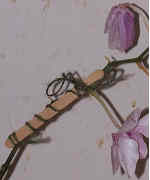 The flower stem grows horizontally if left alone. This is not the best position for displaying the flowers. Therefore, at an early stage while the flower stem is young and supple, tie it to an upright stick.
In the example pictured here the flower stem began leaning badly and I fixed a splint made from a wooden lolly pop stick to help straighten it again.
Friday, December 09, 2005
Earth Goes Into The Red At
World Climate Change Conference - Montreal ?
... ...
United Nations Framework Convention on Climate Change.
... ...
But hey I'm really cool...
I'd settle for a cold winter on any day of the year...
Friday, December 02, 2005
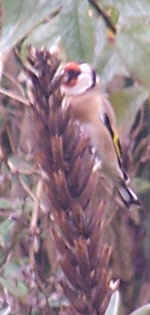
Over Weeding Cleans Out Birds For Winter
Pictured right, a recent siting of Goldfinch gleaning seed heads of Evening Primrose. The yellow flowers born on spikes are lightly scented and attractive to moths. Leaving them to seed risks getting a fresh crop of this biennial flower.
But if I remove them, I clean out all the seeds that are food for these beautiful finches and others. There are many plants that you can leave in for bird food. Berries - Hawthorn, Cotoneaster, Mountain Ash, and Rose-hips, plus seed capsules like Evening Primrose.
The Royal Society For The Protection Of Birds recommend that food be left out for garden birds all year around. That's not surprising as gardens usually degrade the bird's natural habitat and serverely reduce the naturally available bird food.
But in winter especially, gardeners should leave out bird food in squirrel resistant feeders. Specially designed nut mixes are readily available for purchase. Also ensure fresh liquid water is available.
Friday, November 25, 2005
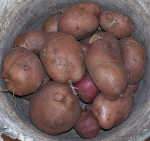
Potato Harvest
This week began as I finished harvesting my pototoes. I grew Desiree in large and strong plastic bags - a sample of the harvest is pictured here.
They taste OK boiled, are firm, and beautifully clean potatoes. The leaves and stems were also clean and green (but I don't eat them of course). Growing potatoes in bags and containers seems to drastically reduce the impact of soil pests (e.g. no slugs), and probably reduces disease too.
But I was a bit disappointed at the yields (maximum 41 tubers from 4 plants in a bag). I'll do better next time. The work involved in container growing should not be underestimated. However, it is ideal for a yard situation.
Saturday, November 19, 2005
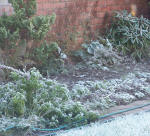
Friday, November 11, 2005
Fall Gardening - Tidying Up
I tidied away the Runner Beans, Sweet Peas and outdoor Tomatoes.
I've already harvested sufficient over ripe pods for next year's seed. But, yesterday there was still about a handful of beans for the pot, and the leaves were green and unblemished. However, low light and temperatures have brought productivity to an end as evidenced by a few bean pods dying back or with wilted tips. So I cut the ties, removed the canes, and broke off the stems at ground level for composting. It's remarkable how swollen and fibrous the bean roots have become.
I also uprooted 2 outdoor tomatoe plants one with a nice fruit truss that will ripen indoors. The sweet peas - a little dissapointing this year - were also removed.
All this organic matter was piled together and chopped with the spade before putting on the compost heap and continuing with more chopping there.
Monday, November 07, 2005
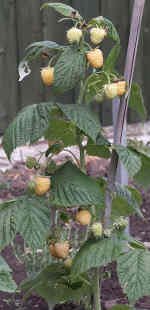 Autumn Raspberries:
Autumn raspberries are a wonderful end to the gardening season. I'm growing the variety All Gold from Suttons Seeds - in U.K. - which has attractive gold coloured fruits.
These attractive autumn fruiting varieties produce fruit in the first year. At this time of year I can't expect loads but, they are a welcome addition to my breakfast cereal. But the season has lasted from 25 August pictured right to the 8 November (left) and still going.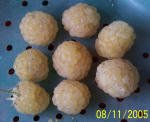 On picking raspberries:
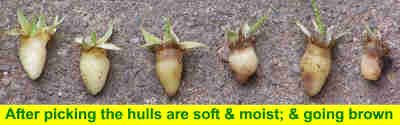
Most gardeners advise that the whole fruit be gently lifted off the central cone or hull when it's ready. But you may notice that the remaining cone shaped receptacle tissue stays fleshy and damp. Soon it begins to go brown. It seems like an open invitation to fungal infection. So after picking the fruit I cut these off with scissors. May be it's unnecessary. May be I'm too fussy. But fruit left too long on the cane or after picking can go creamy pale, soft and squashy. I haven't yet seen significant amounts of botrytis spores.