Wednesday, September 12, 2007

2007 THE GARDENING YEAR SO FAR

It was disappointing to find myself unable to keep a regular updated record of my year. But here are a few exciting highlights.

A WINTER WARMER

As a mild January turned into a mild February the talk was of global warming - early flowering and bird nesting etc... but the dire predictions that young birds would have nothing to eat didn't seem to happen. The facts were not as frustrating as the worst fears. Indeed as always the year took everyone by surprise.

Especially important was the absence of a good ground freeze to kill off the pests and break down the soil. It seemed sad that gardeners could no longer rely on the weather to do this important job.

As March progressed the weather became warmer still. But not all plants are fooled. I noticed no difference in the flowering time of Forsythia or indeed many plants. Magnolia on the other hand did flower earlier and then the flowers were spoiled.

SUMMER COMES WITH A BIG BIG SPLASH

In the U.K. we had the hottest April on record. Garden centres were stocking up on water butts and water holding crystals to add to pots etc... But a parched land scorcher never materialised. May was more overcast and included rainy days.

By the end of May the rains started in earnest. In the U.K. several villages were flooded and these problems were serious. At different locations around the country the floodings were repeated over many weeks. It was very distressing for those involved; many are still out of their home as I write.

At the height of the danger, Tewksbury on the Severn estuary became an island and the streets swamped. Not far away an important power station was literally an inch from complete shut down. This could affect power supplies: heating, lighting and, the pumping of fresh water to houses. The U.K. government with a new Prime Minister - Gordon Brown - faced a crisis. They were right on the brink of putting a massive evacuation into action: hospitals, prisons, old people's homes, houses. Goodness knows what might of happened if the water had not subsided in time - but it did.

Although we had avoided the parched weather, this unusually wet weather was still blamed on climate change. The weather-people told us that the jet stream had, unusually for the time of year, become stationed over the middle of the country bringing with it the rain bearing weather fronts that circle the centres of low pressure.

At the very same time parts of the United States were having a severe heat wave. Perhaps some of these problems might also be attributed to a weak El Ninio event in the southern Pacific, but I'm not clear on this.

CRISIS AFTER CRISIS

As the year moved into its homeward stretches, the new government faced a new "Foot and Mouth" outbreak in the south east. Thankfully this was confined to an area close to the Pirbright laboratory from where the virus had escaped during the floods, partly due to poor maintenance and management of drains. However, the crises still brought a freeze on stock movements in other unaffected parts of the country.

On top of this, animal stock farmers now had to face the appearance of Blue Tongue virus on our shores. Spreading across Europe and rampant in Belgium, it had apparently been transported over the English Channel by a swarm of gnats to an animal sanctuary on the south coast.

May I suggest to sheep farmers that they cultivate some tall herbaceous areas containing strong smelling herbs like Garlic, Cow Parsley, Chervil, Sweet Cicely, Rosemary, Thyme, etc... and have their animals shelter in it and lie down and roll it. There is no vaccine yet available for Blue Tongue disease but organic methods are probably the best protection.

All farmers should keep drinking troughs with clean water every day, and remove any other unnecessary sites of standing water were gnats breed. This last piece of advice had become public information as the damp summer was expected to cause irritation from larger numbers of mosquitoes and gnats.

WHAT ABOUT THE GARDENING?

The mild winter and wet summer was a boon for slugs and snails. They are normally confined to travelling on cools nights but this weather was surely slug and snail heaven. Yet I'm surprised and perhaps a little releived that my plants were not more severely affected. The sprouts got the worst hits. But I had cauliflowers and purple sprouting broccoli that escaped damage and broccoli that was only 50% to 75% damaged.

I came to the conclusion that probably just one pest was responsible for most of the damage. This blighter would attack the same plant, only later did it move on to others. If only I could catch it. It's probably a good tactic to go out at night with a torch.

Actually I tried a range of organic methods, grit, garlic etc... but I'll evaluate these later on the website.

Now winter is here I can hear the thin shrill tweets of birds like Redwing, and Thrush. One report pridicts that many many more garden birds, Robins, Finches, etc... are set to arrive in the U.K. this year from Scandinavia. Better check the bird feeders are stocked up.

Well events have moved on a lot now. The year ends with typical U.K. grey skies and frequently wet and windy days. I'm not displeased with that.

I SAID GOODBYE TO MUM -
A LOVELY, HAPPY, SMILING LADY - LOVED BY FRIENDS AND RELATIVES


Finally I felt much sadness as my mother died in hospital on 31st of December 2007.
+ God Bless her
+ may she rest in peace +
She had been telling everyone that I (her only son) was the best son.
Thanks Mum.
You were the best.

Wednesday, August 29, 2007

MY BIKE DOWNS IN MARCH & APRIL 2007

I'm sure there are many organic gardeners who share my enjoyment in travelling by pedal cycle.

Well, as the darkness of winter retreated it became time to take my bike for repair so I could enjoy the country air and get more exercise during the year as I had promised myself.

I collected my bicycle in the late afternoon and made sure I had new batteries for the lamp. I just couldn't resist taking the country road home but found the dark caught up with me very quickly. I was soon on a familiar country road but it was pitch black. The road camber was steep and my brakes extra sharp after the adjustment. The water company had just finishing using this road to lay new pipes and the left verge had many pools of water.

Well, inevitably a car came along in the opposite direction and I slowed. The combination of my sharp brakes and extra steep camber left me looking for a foothold and the next thing I knew was the sound of wallowing water and cold sodden trousers. Fortunately this was merely a large road side hole and not the roadside ditch. But by far the worst was an appauling stink - not quite what I had planned for getting the country air - the excriment of young bulls and cows from the neighbouring field.

Now that's what I call an adventure and I returned home quite pleased although I had some explaining to do. I would not have missed it for the world and that's a fact. The earth is in my blood - hey folks don't call it 'dirt' - soil is the life blood for your plants and ultimate your cereal, bread, toast...

Little did I know that I was soon to have a second bicyle adventure.

One splendid April morning I was off on my bicyle to the next village for a dental appointment. This was a suburban road and I was passing a school where parents park to pick up and drop off children although it wasn't that exact time of day. I enjoy precision riding and had been cutting quite close to parked cars. The road took a long left turn when suddenly a car drivers door opened right in front of me. I hit the door and somersaulted over the top landing on my back a yard or so further on.

I hardly remember wrapping my collar bone of the top of the door but recollect the eternity of being head first towards the ground before pitching over. I tucked in and landed on my back my head fell back hard onto the road and bounced once or twice as I slid along the road.

I hesitated to collect myself before getting up. It shook me up a bit but I was alright. A man nearby picked my bike up and wheeled it to the side of the road. I felt shaken but I had got off unscathed and I was soon up on my feet. I remember thinking that the lady driver looked disturbed but her first instinct was to grab for the mobile phone. The car door was badly damaged.

The morning sun had been shining straight into the drivers side windscreen and this prevented her from viewing the wing mirror. Plus of course the left bend put me in her blind spot, because we drive on the left in the UK.

cracked bicycle helmet along side new helmet
Cracked Helmet has done it's job
I'm glad that wasn't my head

Lessons to learn from this are:
don't drive too close to parked cars,
check and take extra care if a driver is present,
take care when passing cars around a left bend (U.K.),
keep your windscreen and mirrors crystal clean,
check over your shoulder before pulling out or opening a door into the traffic lane.

Cyclists should ALWAYS WEAR A BICYCLE HELMET

Even if you fall from a stationary bicycle there is considerable danger.
Your head is high off the ground, you don't fall vertically down in a heap, rather the bicycle falls sideways and with further to travel your head picks up more speed. It is harder to cushion a fall from a bicycle by using hands.
Always change your bicyle helmet after it has been damaged.
Always wear your bicyle helmet securely and in the correct position.

Earlier this year a friend of mine hit the curb with his head when something got caught in his bicycle wheel. The accident sounded quite serious for him but I believe he has recovered.

I can't help but admit that after this second event I felt fit, even more of an adventurer and a survivor. In fact I actually felt like starting a new career as an acrobat. I hope that I'm not too accident prone?

But although I continued my journey to the dentist and back home by bicycle I followed the best advice and got public transport to the hospital for a check over. I was fine and the driver recompensed me for my helmet. But I never told Mum a thing about it. Take care.

Friday, December 29, 2006

SIGN FROM THE WINTER GARDEN - A BURNING BUSH?


The mid-day sun is heating the water laden branches and making a column of steam.
But what is this? It's certainly not my next door neighbour having a bonfire.

This steamy column was amazing to watch as it rose vigorously into today's still air. It brought to mind the holy cloud that guided the Isrealites in the wilderness. Am I being led into the garden? Oh dear, perhaps this is to be my 'burning bush' experience.

But I've 'seen the light' and this Christmas the Lord has quietly blessed me on my 'pilgrim journey'. So, what I see here has a 'down to earth' explanation (I'm relieved to say :-)    .

Yesterday brought plenty of rain. Now the ground and the leaves are soaking wet. Today the skies are more or less clear with the mid-day sun shining down at about 33 degrees above the horizon.

The fence is sheltering the hedge from any light wind. The drenched conifer leaves are warming in the sun to provide an extensive area evaporating water. Volume for volume moist air is lighter than dry air. But it does look spectacular.

It is but a microcosm of the weather. Indeed from the same window I have observed clouds climbing into the sky over nearby woodlands. Why? Because the trees are dark in colour and they shelter the ground making it warm. Add to this lots of moisture from the tree leaves and you get a rising air current of the type sought by glider pilots.
A happy new year in the garden to you all.

Thursday, December 28, 2006

ONE CHRISTMAS TIME MEMORY OF EXERCISE

I took my bicycle for a ride to the local mere yesterday. By the time I got there, I may as well of jumped in too, as it had started to rain and I had left my water proofs behind. Circles rippled on the water's surface. The seagulls and the coot were oblivious to it. But ducks and geese were no where to be seen.

I ate a piece of Christmas cake that I'd brought - the birds will not have any I decided. Then I discovered that the man I had passed earlier on the road was nearby also eating his Christmas cake while sheltering under a tree.

Time to go: I rolled downhill to the bridge and over the brook. The noble trees towering around the road gave good shelter. The clinging green Ivy is fruiting.

However, after climbing the next hill the way crossed open fields. My hands began to ache severely in the wet cold air. I had no gloves either. Doggedly on I pushed out into the countryside for 6 or 7 minutes. I had a cold coming on that left me reaching for tissues. The way back led past the local golf links. With not a soul about, all was strangely hushed and very still.

Then the challenge was a long run down to pedal all the way up the steeper hill beyond. I took care on the wet road not to lean the bike into right turns where the camber provides less grip. I had learned to lean forward and steer rather than pull back as if a crash was imminent. Then I power up the other side at a good speed while changing down gears and following a smoothly controlled line near the curb. If only this precision was an olympic sport.

Did that feel better than last time? At the top; wow, that felt better. That exercise will set me up for the whole day. I know from taking blood sugar tests that its effect continues for many hours afterwards. Its just what I need when on holiday and after Christmas festivities.

Home was in sight, and although it felt prudent to make haste, the pain of cold was long forgotten. It had been a bit of a stretch to face down the weather and the distance, and on this simple journey - to do small things well.

Thursday, December 21, 2006

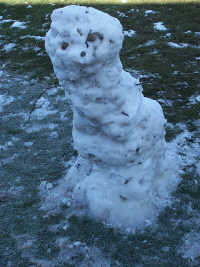
Sean's snowman from last
February 2006
HAPPY CHRISTMAS TO SEAN & RYAN

Well made Sean - Now you can show all your mates this picture of the snowman that you made last year in your Grandma's garden. It melted a bit before I got the picture.

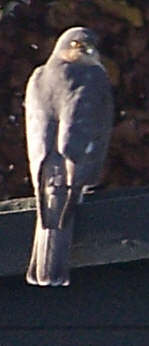
Go down page or click link to see a picture of a Kestrel in my garden. Kestrels have a sharp hooked bill, sharp talons and, they can see small things from a distance. This Kestrel was looking to catch small birds to eat. It also eats mice.

Tuesday, December 19, 2006

WAITING FOR SUMMER TO END

Well I complained about the short dark days and the wet (I hope it means we avoid summer water shortages). But really it is so warm I hardly need put a coat on when I go out. Gardening would be very comfortable. Conditions are far from the hard frozen ground and biting chill one might expect this time of year.

SOME GARDENING
A week or two ago I planted 2 new Gooseberry bushes, the thornless red berried 'Pax' and the renowned apricot flavoured Hinnonmaki Yellow - to add to my collection.

Gooseberries fit nicely into a small garden. They arrived in good condition as bare rooted plants available to UK gardeners here.

I also received 15 Strawberry plants from Suttons 4 month collection comprising varieties: Mae, Flemenco, and Alice. Actually I got an extra plant. I've been able to plant these too. I think it is good to order early.

If all goes well I intend to construct a new greenhouse this year. Then the strawberries will be planted into the greenhouse beds.

NATURE

I was out early evening along a dark country lane when I was surprised to see light coloured moths fluttering in the car headlights. They were quite numerous along the tree and hedge lined roads. I had expected such creatures to be confined by the cold at this time of year. But not so. Then last night there was one outside on my window. Nature is certainly thriving.

Some predatory birds nearly became extinct when DDT was used as pesticide. But how did it get into these birds?
The garden birds are very numerous and active - the sparrows have made a big come back after almost disappearing. Much is due to my neighbours who keep the bird food topped up in several feeders. The Robin has been very prominent and makes its prescence known every time I go into the garden. But there have also been Kestrels sitting on my garden posts waiting for a kill.

Like it or not we live in an interdepedent existence with the animals and plants that share the planet with us. So I'm thrilled to see life prospering in the garden and the countryside.

Thinking as a biologist for a moment: we describe the ecological niche of different animals, but we never ask of ourselves - what is the human's ecological niche? What is our place in nature? Are we predators, organic recyclers, farmers, or just a horrible disease? Shouldn't we try to fit in somewhere rather than twist and disturb everything? We disturb the interdependency of life at our peril.

Saturday, November 25, 2006

SLUSHED OUT OF THE GARDEN

Pleasant days and an enjoyable gardening year made me believe I could carry on gardening in spite of the season.

I had simply forgotten the extent to which shorter days limit the time available in which to do anything.

At the beginning of November a few wet days were not enough to keep me off the soil. But now the soil has been thoroughly drenched and I have to keep off it. Walking on soil or lawn now, compacts the ground. Attempting to work it with rake or cultivator turns it to a sticky slush.

Greenhouse gardeners will no doubt still be happily pottering around and fussing over tender flowers and seedlings.

Even so I believe that given a dry spell I could spread some garden compost over the surface outdoors, and while standing on a pathway, lightly work it in using a garden fork.

Indeed I used this to plant 30 Shallots. The variety Grisselle is planted in Mid October to December before the ground freezes. It gets a head start on the Shallot varieties that are normally planted in Spring.

I've been buying a few shrubs and perennials. A recent purchase included Corylus avellana 'Contorta - Red Majestic'. I got this one at a reduced price from a Focus DIY closing down sale. Nevertheless, it reminded me how expensive these outlets can be for plant purchases.

Wednesday, November 08, 2006

THE DISMAL ALIENS

The ladybird is a highly valuable insect for controlling aphids. Unfortunately it is being overrun by another beetle. This is the dismal truth of the Harlequin Beetle Harmonia axyridis. Following introduction into America in 1988 it has now become more widespread there than ordinary Ladybirds. Now it is advancing rapidly through the U.K.

The Harlequin was originally introduced for its voracious appetite for eating aphids and so protecting crops. But things have got out of hand. If its success continues it could result in a reduction in biological diversity i.e. the number of different types of insect that we have in our gardens. That is not good.

Plans are being made to control it e.g. by using insect attractants to lure the Harlequin into a trap. I recommend that gardeners learn to distinguish the Harlequin from normal Ladybirds. see the Harlequin Survey. It seems only right to keep a keen eye open for them and destroy them where they are found. Anything to halt their advance must be good.

...and FLAT WORMS
The New Zealand Flatworm, Arthurdendyus triangulatus, is another alien, first found in 1963 in Northern Ireland. It has probably traveled among potted plants and now exists throughout the U.K. Other reports suggest that eggs may travel in stone filled field drains.

This Flatworm eats our own native earthworm. In some areas this alone is blamed for causing poor field drainage and waterlogging - a devastating result.

As organic gardeners we need be more responsible custodians of our environment.

Wednesday, November 01, 2006

AUTUMN RASPBERRY GOLD LOVES COLD

My autumn Raspberry 'All Gold', described earlier, has come into fullness this week.

Although I've been getting Raspberries for over 2 months, they are much better now. They are firmer, they stand better, free of molds, and taste good. The colder weather is doing them good.

A month ago I was waiting for the calyx (i.e. the leafy appendiges beneath the fruit) to curl back to indicate the fruit was ripe and good to eat. The space between ripeness and decay was quite short. I've had very few in recent weeks. But I had noticed that there were many green fruit yet to ripen.

Well now they are swelling to become fat jucy fruits that remain good on the branch, but eventually, they are just too big and good not to be picked.

Don't forget - you can add your comments on any of my notices. Thanks for reading.

Sunday, October 29, 2006

My soil contains sufficient clay to form these smooth shapes
KEEP OFF SODS & SOIL

This week has brought a lot of rain. With lower temperatures 'to boot' the garden has reached that 'tipping point' where the soil is too wet to work on. Any work with rake or cultivator turns it to mud.

I can only hope for an extended spell of drier days that may allow me to do a few outstanding jobs. I can now look forward to jobs like pruning fruit, moving a few shrubs, paving stones and putting in a few posts.

The wormery is very active!
Photo shows a small part of a mass of tiny baby worms and worm eggs


Note: while many garden centers promote herbaceous perennials and shrubs during their summer blossoming, that is in not a good time to move bare rooted plants. But now is a good time to plant new shrubs. See transplanting shrubs on the Organic Gardener.

Tuesday, October 24, 2006

LEARNING TO SWITCH OFF

Hello again. Today there have been more reminders in the news about how to reduce energy demands. This is necessary to slow the sharp rise in 'greenhouse gas' that is threatening our environment. While switching off electrical appliances that are on stand-by, and battery chargers left plugged in etc... were mentioned, I'd like to give a few ways to save energy in the garden.

Overall the massive and widespread expansion in the use of power seriously threatens the environment that sustains us. The development of power machines for every kind of domestic gardening job must also add significantly to this energy drain.

Nowadays, summer weekends in suburbia are shattered with the roaring din of not one, but many types of power machines all over the neighbourhood: mowers, hedge trimmers, blo-vacs, lawn scarifiers, strimmers, you name it. It seems that no one knows how to do a job without a plug-in. Nationwide 'power gardening' alone must cause a massive extra drain on resources and cause a massive significant increase in carbon dioxide production to generate the power needed.

But do these machines help us as much as we think? When I need every bit of encouragement to get out and mow the grass I find the thought of dragging out a heavy mower and messing around with electric cables is just enough to put me off. Wrestling with trailing cables for me, simply spoils the fun of gardening.

By contrast my manual mower is small, light, easy to get out, and carry around, and it can be wizzed around the lawn in no time. In fact, I can almost run with my side wheeled mower - and it does a good job on the grass too. (You've probably guessed that I'm frequently in a hurry.)

There's no doubt in my mind that for a normal domestic garden situation, a power mower is a waste of energy - and I feel so much healthier and fitter after doing the grass with a push mower.

If you must choose a power mower then can I suggest not getting an oversized mower. The extra weight, storage space and manouverablity are considerations. Take hover mowers for example. Qualcast only make a small hover mower because the additional weight of a grass box and the more powerful heavier motor that is needed - ...yes, to lift its own weight! - is so inefficient. A link to more detailed discussions on using and choosing lawn mowers and lawn care is on this page.

IS AFFLUENCE THE MEASURE OF ILL-HEALTH?

I believe that power machines, including cars, are for the elderly and the disabled, and those rough gardening situations (e.g. slopes), that call for a heavy duty machine. But they are also often used by the unfit (or, dare I say, lazy). But don't kid yourself that obesity is fashionable or good. Get into your garden and get healthy. With fresh organic food it gives you just about a complete work out.

Now if you're stuck in an office on weekdays you can really look forward to the garden at weekends.
First: flush out the stuffy office with a few deep, deep breaths in; each followed by an exhale right, right out...

Then do a few gentle bending and stretching exercises... do you feel better now?
Then get on with the lawn and take in the gentle smell of the fresh mown grass, cut chammomile, lemon balm etc...

It's a question of priorities where quality of life comes first. I hope that you have a good harvest.

Friday, October 13, 2006

BE ORGANIC, COMMUNITY MINDED & SHARE YOUR GARDEN PRODUCE


The benefits of sharing with neighbours are obvious for anyone who has a big harvest. If you can in return get something back that you didn't grow then you can serve up a more exciting meal.

If a glut of garden produce only serves to feed everyone on the same meal for weeks until they are literally fed up with it, then it is not going to be appreciated. But a varied diet is usually a good thing.

How much better if you can be community minded and help each other out. Perhaps even arrange to grow different crops so that you can all share and have a little of everything.

This year one of my neighbours kindly brought around a large bag of tomatoes, while another supplied an equally large bag of plums. I have returned with a small share of my potato crop.

Also speaking of neighbourliness, don't forget the elderly who can't so easily get out to shop or even perhaps to grow in their gardens. They are always very appreciative of fresh garden gifts as they grew up in an age when cooking was the norm unlike the fast-food fanatics of today.